Nerds Candy Facts — History, Science & Flavor Innovations
✨ This article was AI edited. Editorial responsibility: FoodieCX.com.
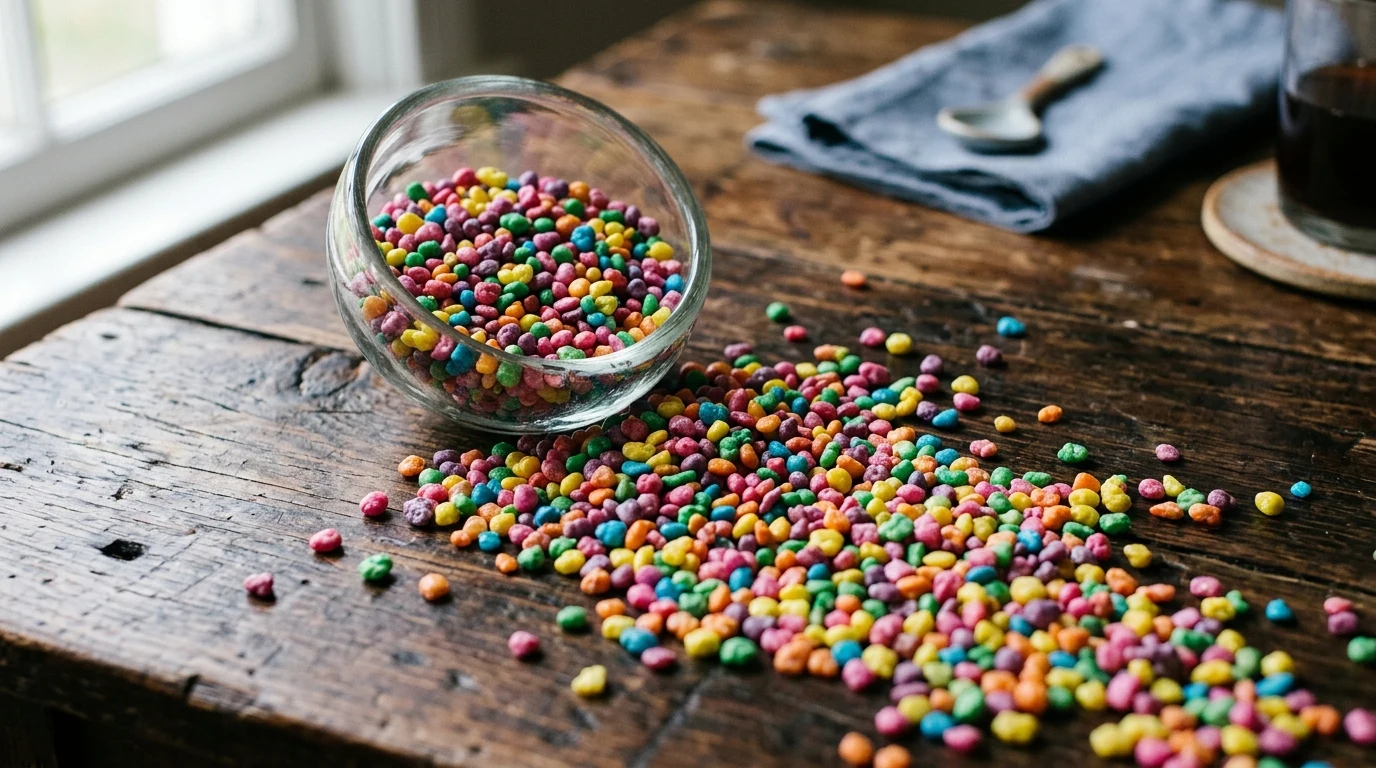
Nerds candy facts reveal that the iconic dual-flavored confection was invented in 1983 by candy pioneer Angelo Fraggos under the Willy Wonka Candy Company, engineered through an industrial sugar-panning process that crystallizes dextrose syrup around microscopic sugar seeds, creating irregularly shaped, tangy, crunch-coated confectionery pebbles.
For more than four decades, Nerds candy has captured the imagination and taste buds of confectionery lovers worldwide. Recognizable by its whimsical mascot illustrations, vivid color contrasts, and signature two-compartment dispensing boxes, Nerds is more than just nostalgic junk food—it is an extraordinary triumph of food engineering, industrial panning science, and pop-culture branding.
From its origins in the golden age of Wonka-branded confections to the modern renaissance of Nerds Gummy Clusters, the story behind these tangy little pebbles is packed with surprising industrial secrets, historical trivia, and chemical ingenuity, echoing the fascination behind other beloved treats as explored in our deep dives into Reese’s candy ingredients and nutritional impacts and food additives like PGPR in chocolate manufacturing.
Contents
- The Origins: Willy Wonka, Sunmark, and Angelo Fraggos
- 20 Fascinating Nerds Candy Facts You Never Knew
- 1. Etymology: The Dr. Seuss Connection
- 2. The Panning Process: How Nerds Are Grown, Not Molded
- 3. The Secret Acid Profile: Malic vs. Citric Acid
- 4. The Engineering Behind the Dual-Chamber Box
- 5. The First Wonka Candy With Two Simultaneous Flavors
- 6. Nerds Cereal Actually Existed in the 1980s
- 7. Giant Chewy Nerds Revolutionized the Texture Portfolio
- 8. The Dextrose Advantage: Fast-Metabolizing Energy
- 9. The Mascot Lore: Genderless Wonka Creatures
- 10. The Discontinued Nerds Rope Origin Story
- 11. Nerds Gummy Clusters: The Modern Billion-Dollar Breakthrough
- 12. The Carnauba Wax Coating
- 13. The Controversial Mystery Flavor Campaigns
- 14. Extreme Flavor Experiments: Hot ‘n’ Cold to Bacon
- 15. Gluten-Free and Fat-Free Status
- 16. The Color Shift in Natural Light
- 17. International Flavor Variations
- 18. The Pop-Culture Phenom on Television
- 19. Gelatin-Free vs. Gelatin-Containing Formulations
- 20. The Ferrara Candy Era
- Nutritional Overview: What’s Inside a Box?
- Frequently Asked Questions
The Origins: Willy Wonka, Sunmark, and Angelo Fraggos
In the late 1970s and early 1980s, the St. Louis-based Sunmark Companies operated the Willy Wonka Candy Factory brand under license from Roald Dahl’s fictional universe. Seeking an innovative candy that delivered high flavor impact, low production cost, and playful tactile engagement, food developer Angelo Fraggos led the team that engineered Nerds.
Debuting nationally in 1983, Nerds was immediately hailed by the National Candy Wholesalers Association (NCWA) as “Candy of the Year.” The initial rollout featured the legendary pairing of Strawberry and Grape, forever establishing the dual-flavor, dual-door packaging archetype.
20 Fascinating Nerds Candy Facts You Never Knew
1. Etymology: The Dr. Seuss Connection
While commonly associated with studious intellect or social awkwardness today, the word “nerd” was actually coined in 1950 by Theodor Seuss Geisel (Dr. Seuss) in his children’s book If I Ran the Zoo. The character was described as “a nerd in a comical birdcage.” Sunmark marketers appropriated the term to symbolize the candy’s delightfully odd, quirky, and imperfect physical appearance.
2. The Panning Process: How Nerds Are Grown, Not Molded
Nerds are not pressed into molds like Smarties or stamped like candy wafers. Instead, they are manufactured using an industrial technique known as sugar panning. Microscopic sugar crystal seeds (often single grains of dextrose) are loaded into massive, rotating heated stainless steel drums. As the drums spin, liquid sugar syrup and food-grade acidulants are repeatedly misted onto the tumbling grains over several hours, causing each pebble to grow irregularly layer by layer.
| Manufacturing Stage | Industrial Mechanism | Ingredient Interaction | Physical Transformation |
|---|---|---|---|
| 1. Seeding | Dextrose crystal introduction | Pure crystalline glucose | Provides the microscopic nucleation core for crystal growth. |
| 2. Grossing & Acid Layering | Rotary drum tumbling + syrup spraying | Corn syrup, malic acid, citric acid | Builds uneven topography; acid crystals infuse intense sourness. |
| 3. Color & Flavor Glazing | Liquid pigment atomization | FD&C dyes, concentrated flavor oils | Imparts signature vibrant hues and sharp fruit aromatics. |
| 4. Polishing & Sealing | Carnauba wax finishing | Carnauba wax / confectioner’s glaze | Locks in moisture, prevents clumping, yields glossy sheen. |
3. The Secret Acid Profile: Malic vs. Citric Acid
The distinctive, puckering tang of Nerds comes from a precise ratio of malic acid and citric acid. While citric acid provides an immediate, sharp initial sour note, malic acid possesses a prolonged, lingering acidity that enhances salivary stimulation and amplifies fruit perceptions.
4. The Engineering Behind the Dual-Chamber Box
The dual-compartment box with sliding pull-tabs was an industrial packaging breakthrough in 1983. Designed to keep opposing flavor profiles completely segregated during shipping and shelf life, the internal paperboard divider prevented moisture migration between tart and sweet varieties.
5. The First Wonka Candy With Two Simultaneous Flavors
Nerds pioneered the consumer concept of flavor contrast in a single package. Rather than forcing kids to choose between grape or strawberry, the packaging empowered consumers to enjoy each flavor independently or combine them into a custom sweet-and-sour fusion.
6. Nerds Cereal Actually Existed in the 1980s
In 1985, Ralston Purina partnered with Wonka to launch Nerds Cereal. Emulating the candy box, the cereal featured a dual-compartment interior with two separate bags: Orange/Cherry and Strawberry/Grape. The cereal box even included a cardboard partition so kids could pour two distinct cereals into the same bowl without pre-mixing them in the box.
7. Giant Chewy Nerds Revolutionized the Texture Portfolio
In 2001, Wonka introduced Giant Chewy Nerds. Unlike their tiny, rock-hard counterparts, these featured a soft, jelly-bean-like chewy interior encapsulated by the traditional crunchy Nerds shell, laying the conceptual groundwork for the modern gummy cluster.
8. The Dextrose Advantage: Fast-Metabolizing Energy
The primary ingredient in Nerds is pure dextrose (glucose), rather than sucrose (table sugar) or high-fructose corn syrup. Dextrose is chemically identical to blood sugar, meaning it bypasses liver fructose metabolism and enters the bloodstream rapidly, explaining the immediate energetic rush experienced by consumers.
9. The Mascot Lore: Genderless Wonka Creatures
The anthropomorphic creatures that adorn Nerds boxes were designed by illustrator Tom Rozakis. Officially referred to as “Nerds creatures,” these colorful, big-nosed, blob-like beings were deliberately designed without gender or distinct biological characteristics to emphasize universal whimsy and playful mischief.
10. The Discontinued Nerds Rope Origin Story
Nerds Rope was invented by accident in 1996 when a factory worker in Sunmark’s research lab drizzled experimental gummy gelatin mixture over a tray of spilled Nerds pebbles. When the gummy solidified, it bound the crunchy pebbles into a flexible, bendable candy rope that became an instant commercial phenomenon.
11. Nerds Gummy Clusters: The Modern Billion-Dollar Breakthrough
Introduced in 2020 by parent company Ferrara Candy Company, Nerds Gummy Clusters paired a soft, fruity gelatin core with miniature rainbow Nerds. In 2023, Gummy Clusters generated over $500 million in sales, outperforming major chocolate bars and sparking viral trends across TikTok and social media.
12. The Carnauba Wax Coating
Nerds utilize carnauba wax—derived from the leaves of the Brazilian palm tree Copernicia prunifera—as their final polishing agent. This food-grade vegetable wax gives Nerds their glass-like shine and prevents individual pebbles from melting together when exposed to atmospheric humidity.
13. The Controversial Mystery Flavor Campaigns
In 1998, Wonka launched limited-edition “Mystery Nerds,” where white-colored pebbles masked intense, unexpected flavors. Fans were invited to submit their guesses by mail for a chance to win trips to Universal Studios.
14. Extreme Flavor Experiments: Hot ‘n’ Cold to Bacon
Over the decades, Nerds has experimented with daring seasonal pairings, including “Hot ‘n’ Cold” (cinnamon hot vs. wintergreen cool), “Sour & Squeezy,” and novelty holiday editions like “Frosty Nerds” (Watermelon, Wild Cherry, and Punch).
15. Gluten-Free and Fat-Free Status
Nerds candy is inherently fat-free and contains no wheat, barley, or rye derivatives. While manufactured in facilities that process dairy and tree nuts, standard Nerds are widely considered gluten-free by celiac advocacy groups.
16. The Color Shift in Natural Light
Because the outer shell consists of microscopic microscopic crystalline facets, Nerds exhibit thin-film light scattering. Under direct sunlight, colors appear significantly brighter and more multi-tonal than under fluorescent store fixtures.
17. International Flavor Variations
In Australia and New Zealand, Nerds are sold under the Nestlé banner with localized flavor varieties, including “Passionfruit & Pineapple” and “Wildberry & Peach.”
18. The Pop-Culture Phenom on Television
Nerds candy has been famously featured in iconic television shows, including Seinfeld, Stranger Things, and The Big Bang Theory, frequently serving as an aesthetic symbol of 1980s retro youth culture.
19. Gelatin-Free vs. Gelatin-Containing Formulations
While traditional boxed crunchy Nerds contain no animal gelatin and are considered vegetarian-friendly, Nerds Gummy Clusters and Nerds Ropes rely on porcine or bovine gelatin to achieve their chewy gummy core.
20. The Ferrara Candy Era
In 2018, Italian confectionery giant Ferrero (the maker of Nutella and Ferrero Rocher) acquired the Nestle U.S. confectionery division, placing Nerds under its Chicago-based subsidiary, Ferrara Candy Company, which spearheaded a multi-million-dollar modernization of the brand’s production lines.
Nutritional Overview: What’s Inside a Box?
A standard 1.65 oz (46.7g) single-serve box of Nerds delivers:
- Calories: 180 kcal
- Total Fat: 0 g
- Sodium: 0 mg
- Total Carbohydrates: 44 g (all sugars from dextrose)
- Protein: 0 g
Because they are virtually pure simple carbohydrate with zero fiber or fats, Nerds should be viewed as an occasional sweet treat rather than a sustained source of energy.
Frequently Asked Questions
How are Nerds candies made?
Nerds are made through an industrial panning process where microscopic dextrose sugar crystals tumble in large rotating drums while being sprayed with flavored corn syrup, malic acid, and food coloring over several hours until small, irregular crunchy pebbles form.
Are Nerds vegan?
Standard hard-boxed Nerds do not contain animal-derived gelatin or dairy, but they may use confectioner’s glaze, carnauba wax, or carmine dye (in specific red/pink batches) depending on regional manufacturing. Nerds Gummy Clusters and Nerds Ropes contain animal gelatin and are not vegan.
Who invented Nerds candy?
Nerds candy was developed by candy creator Angelo Fraggos and introduced in 1983 by the Willy Wonka Candy Factory (Sunmark Companies).
Get our latest guides, news, and insights highlighted in your Google Search & AI Overviews.