
Crab Cakes with Remoulade Sauce — Authentic Maryland Recipe
✨ This article was AI edited. Editorial responsibility: FoodieCX.com.
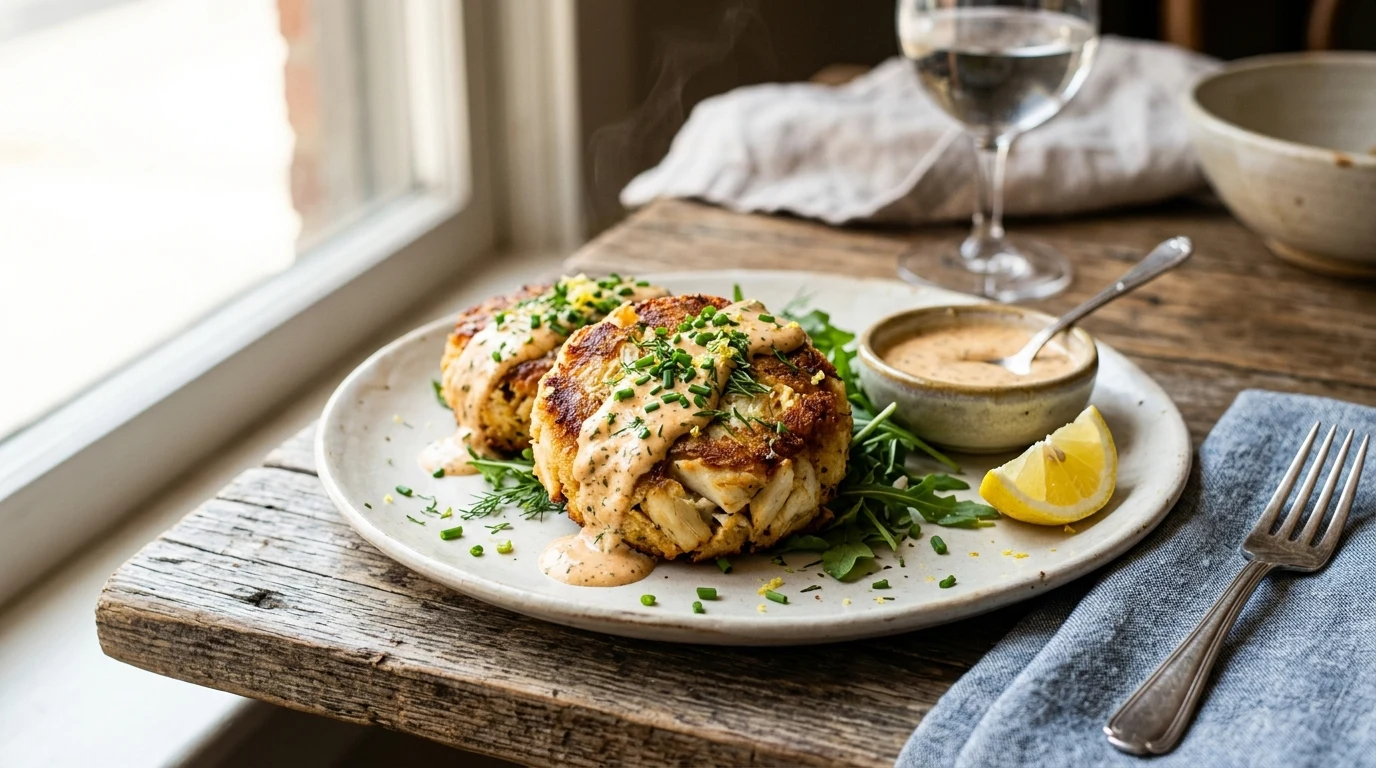
Crab cakes with remoulade sauce is a classic coastal American seafood dish combining pan-seared jumbo lump blue crab meat—bound with minimal egg, Dijon mustard, and crushed crackers—paired with a piquant, cold emulsion sauce made from mayonnaise, Creole mustard, horseradish, capers, fresh lemon juice, and smoked paprika that cuts through the crab’s natural rich sweetness.
Among the treasures of American regional gastronomy, few preparations rival the delicate decadence of authentic Mid-Atlantic crab cakes paired with a classic remoulade sauce. Originating along the brackish estuaries of the Chesapeake Bay and refined through the vibrant culinary corridors of New Orleans, this pairing represents a masterclass in flavor contrast: sweet, succulent, tender crustacean meat balanced against a zesty, creamy, acidity-forward emulsion.
Yet, home cooks and professional kitchens alike frequently stumble on two critical fronts: overburdening the crab cake with excessive breading filler, and treating remoulade as nothing more than spiced mayonnaise. To achieve restaurant-caliber excellence, one must respect the anatomy of crab meat and understand the emulsification chemistry that defines world-class sauces, as explored in our fundamental guides to what defines a condiment and culinary essentials of flavor-pairing spreads.
Contents
Selecting the Crab Meat: Grading and Sourcing
The foundation of an unforgettable crab cake is the grade of crab meat selected. Blue crab (Callinectes sapidus) provides unmatched sweetness and delicate texture. Commercial crab meat is classified into four distinct commercial grades:
| Crab Meat Grade | Anatomical Origin | Texture Profile | Culinary Application |
|---|---|---|---|
| Jumbo Lump | Large swimming muscle chambers behind paddle fins. | Massive, unbroken, pristine white chunks with tender, buttery flake. | The premier choice for luxury showcase crab cakes. Requires gentle folding to preserve chunks. |
| Lump Crab | Mixture of smaller broken jumbo pieces and body meat. | Medium flakes, bright white, resilient texture. | Ideal workhorse grade; excellent flavor-to-cost ratio, superb binding capability. |
| Backfin | Smaller body meat flakes mixed with lump remnants. | Fine, flaky shreds with pronounced sweetness. | Best blended 50/50 with Jumbo Lump to lock together cake structure without excess binder. |
| Claw Meat | Extracted from active pincers and claws. | Darker, reddish-brown hue with robust, assertive seafood intensity. | Superior for crab dips, gumbos, and bisques; can overpower delicate pan-seared cakes. |
Pro Tip on Inspection: Even pasteurized lump crab from top-tier purveyors may contain microscopic shell fragments. Gently spread the crab across a chilled stainless steel baking sheet and probe lightly with your fingertips. Never rinse the meat with water, as excess moisture dilutes the natural crab liquor and ruins structural binding.
The Golden Binding Ratio: Less Is Always More
Traditional Maryland style dictates that binders exist solely to hold the meat together until the proteins coagulate in the pan—not to stretch volume. For one pound (16 oz) of jumbo lump crab meat, the ideal binder emulsion consists of:
- 1 large whole egg (lightly beaten for protein coagulation)
- 2 tablespoons high-quality mayonnaise (adds moisture without heaviness)
- 1 teaspoon Dijon mustard or stone-ground Creole mustard
- 1 teaspoon Worcestershire sauce (adds subtle umami and depth)
- 1 tablespoon freshly squeezed lemon juice
- 1 to 1.5 teaspoons Old Bay seasoning or Chesapeake Bay spice blend
- 1/3 cup finely crushed saltine crackers (approx. 8–10 crackers)
Why Saltines Outperform Breadcrumbs: Traditional panko or breadcrumbs absorb liquid rapidly and turn gummy under heat. Finely crushed saltine crackers contain baked shortening and fine flour lattices that gelatinize gently, creating an invisible structural web that allows the crab meat to remain the star.
The Science of Remoulade: French Classical Roots vs. Louisiana Creole
Remoulade originated in classical French cuisine as a cold derivative of mayonnaise flavored with mustard, capers, chopped gherkins, and fresh herbs (chervil, tarragon). However, when French culinary traditions met Spanish, Caribbean, and African influences in Southern Louisiana, remoulade evolved into an assertive, multi-dimensional sauce featuring Creole whole-grain mustard, freshly grated horseradish, garlic, cayenne, and smoked paprika.
Understanding the distinction between spreads and condiments is essential here, as outlined in our culinary breakdown of spread vs. condiment distinctions. In this pairing, remoulade functions as a high-acidity contrast agent: the sharp bite of isothiocyanates from horseradish and the lactic tang of mustard cut cleanly through the rich, buttery mouthfeel of pan-seared crab.
| Component | Quantity | Flavor Role in Remoulade |
|---|---|---|
| Mayonnaise (Base) | 1 cup | Lipid carrier providing emulsion stability and coating mouthfeel. |
| Creole Stone-Ground Mustard | 2 tablespoons | Aromatic crunch, vinegar tang, and sharp mustard-seed pungency. |
| Prepared Horseradish | 1 tablespoon | Nasal heat and sinus-clearing freshness that balances seafood sweetness. |
| Non-Pareil Capers (Drained & Minced) | 1 tablespoon | Salty, floral briny pops that complement the ocean notes of blue crab. |
| Smoked Spanish Paprika | 1 teaspoon | Earthy campfire aroma and vibrant coral color. |
| Fresh Lemon Juice | 1 tablespoon | Bright citric acid that balances rich egg fats. |
| Fresh Scallions & Parsley (Minced) | 2 tablespoons | Herbal freshness and visual contrast. |
Step-by-Step Cooking Technique: Pan-Seared Perfection
Step 1: Emulsify the Binder Base
In a wide glass mixing bowl, whisk together the egg, mayonnaise, Dijon mustard, Worcestershire sauce, lemon juice, and Old Bay seasoning until completely homogenous and pale yellow. Stir in the crushed saltines and let rest for two minutes so the crackers lightly absorb the liquid.
Step 2: The Gentle Fold
Add the inspected jumbo lump crab meat into the bowl. Using a wide silicone spatula, fold from the bottom upward with broad, deliberate strokes. Rotate the bowl as you fold. The objective is to coat every lump of crab in the binder without crushing the delicate muscle fibers.
Step 3: Shape and Chill (The Non-Negotiable Step)
Divide the mixture into 6 equal portions (roughly 1/3 cup each). Using wet hands or a ring mold, shape into thick, circular patties approximately 1 inch high. Place them on a parchment-lined baking sheet, cover loosely with plastic wrap, and refrigerate for a minimum of 30 to 45 minutes. Chilling allows the cracker starches to hydrate fully and firms the fats, ensuring the crab cakes do not disintegrate upon hitting the hot skillet.
Step 4: Pan-Searing in Clarified Butter and Oil
Heat a heavy 12-inch cast iron skillet over medium heat. Add 2 tablespoons of clarified butter (ghee) and 1 tablespoon of neutral high-smoke-point avocado oil. Once shimmering (approx. 350°F / 175°C), gently transfer the chilled crab cakes into the skillet, leaving 2 inches between each cake.
Sear undisturbed for 3 to 4 minutes until a deep golden-brown, crispy crust develops. Gently flip using a thin fish spatula and sear the reverse side for an additional 3 minutes, or until the internal temperature registers 145°F (63°C) on an instant-read digital thermometer.
Pairing and Presentation Suggestions
Serve crab cakes hot immediately from the skillet. Spoon a generous smear of chilled remoulade sauce across the plate, set the crispy golden cake atop, and garnish with fresh microgreens, snipped chives, and grilled lemon wedges. For elevated casual dining, these cakes make an extraordinary centerpiece, rivaling top gourmet offerings as seen in our curation of the best burger and sandwich condiments.
Frequently Asked Questions
What is the secret to keeping crab cakes from falling apart?
The secret is chilling the shaped cakes in the refrigerator for at least 30 to 45 minutes before cooking. Chilling solidifies the fats and allows cracker starch to bond with egg proteins. Additionally, avoid overworking the mixture or flattening the patties in the pan.
Can crab cakes be baked instead of pan-seared?
Yes. Preheat your oven to 425°F (220°C). Place the chilled crab cakes on a greased baking sheet, brush the tops generously with melted butter, and bake for 12 to 15 minutes until golden and heated through to 145°F internally.
How long can homemade remoulade sauce be stored?
Stored in an airtight glass jar in the refrigerator, homemade remoulade sauce remains fresh for up to 7 days. In fact, remoulade improves after 2 to 4 hours of refrigeration, as the spices, horseradish, and garlic fully infuse into the mayonnaise emulsion.
Get our latest guides, news, and insights highlighted in your Google Search & AI Overviews.


